Product Design
Medical Device Product Development: Key Design Considerations

By Alex A
Head of Engineering


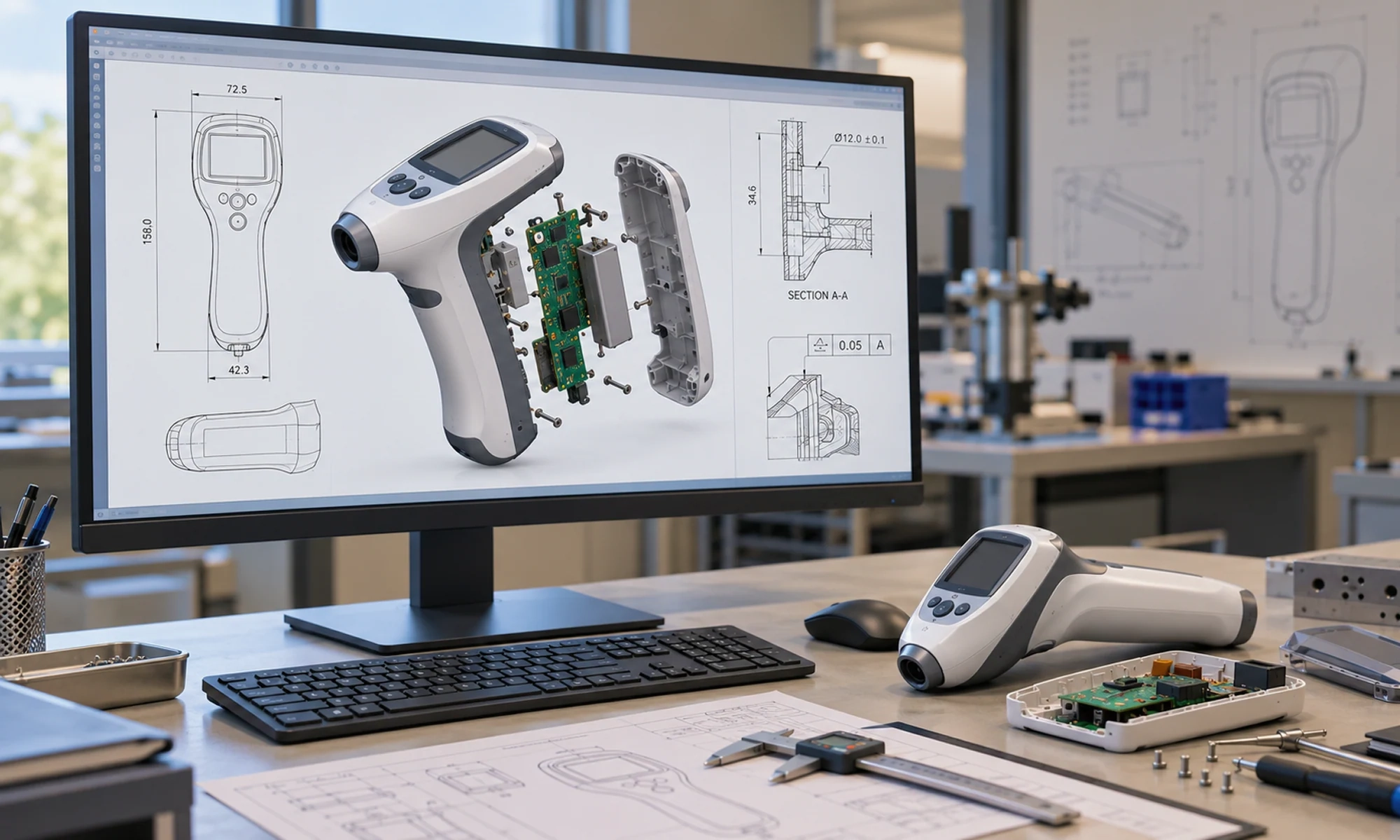
A medical device may look simple. But behind that product is a long list of engineering decisions.
How should it work? What materials should be used? How will it be manufactured? Can it withstand repeated use, cleaning or sterilization? What happens if a component fails?
These questions need to be answered as the device moves from an initial concept to a production-ready product. A good design must work as intended while also being practical to manufacture, use and maintain.
This makes medical device product development a process of balancing different engineering requirements. Mechanical design, material selection, prototyping, testing, manufacturability and standards all play a role.
This blog explores the key design considerations in medical device product development. It also looks at common device types, relevant standards and the engineering stages involved in taking a device from concept to manufacturing.
Types of medical devices and their design requirements
Medical devices serve very different purposes, so their development requirements can vary significantly. A device used to monitor a patient's condition has different priorities from a drug delivery device, surgical instrument, or rehabilitation system.
The table below highlights common medical device categories, examples and the primary product-level requirements that influence their development. These requirements are specific to the device's intended function and use environment; the detailed engineering considerations used to achieve them are discussed in the following section.
| Medical Device Type | Examples | Key Design Requirements |
|---|---|---|
| Medical imaging equipment | X-ray systems, ultrasound equipment, imaging scanners | Image quality, positioning accuracy, system stability, patient safety and reliable operation |
| Diagnostic and monitoring devices | Patient monitors, diagnostic analyzers, vital-sign monitors | Measurement accuracy, repeatability, reliability and clear user feedback |
| Drug delivery devices | Infusion pumps, injection devices, inhalers | Accurate dosing, controlled delivery, reliable operation and safe handling |
| Surgical and procedural devices | Surgical instruments, procedure-specific equipment | Precise operation, dependable performance, safe handling and suitability for clinical use |
| Implantable devices | Hip and knee implants, spinal implants, bone plates and screws | Biocompatibility, dimensional accuracy, mechanical strength, fatigue resistance and long-term use |
| Rehabilitation and assistive devices | Mobility aids, rehabilitation equipment, patient support devices | Patient safety, ease of use, adjustability, durability and functional support |
| Wearable medical devices | Wearable monitors, sensors, portable medical devices | Portability, comfortable use, reliable monitoring and continuous operation |
| Laboratory and testing equipment | Laboratory analyzers, sample handling and testing equipment | Measurement accuracy, repeatability, efficient operation and contamination control |
Key design considerations in medical device product development
A medical device can have a clear purpose and still be challenging to design for real-world use. As the concept takes shape, several design decisions can affect its performance, reliability, manufacturability, usability and overall development costs.
Here are the key design considerations when turning a medical device concept into a final product:
1. Functional requirements
Every medical device starts with a set of functional requirements. These define what the device needs to do and how it should perform.
Depending on the device, the requirements may cover performance, operating conditions, expected loads, accuracy, dimensions, duty cycle, and service life. They can also define how users will interact with the product.
These requirements provide the basis for the design. They help engineers determine the appropriate mechanisms, components, materials, tolerances, and manufacturing approach.
2. Mechanical design
Mechanical design turns the functional requirements into a physical product. It defines how the components fit together and how the device will work as a complete assembly.
Depending on the device, this may include enclosures, mechanisms, housings, structural components, fixtures, or complete assemblies.
In this stage, engineers consider clearances, component interfaces, operating loads, and potential failure points as the design takes shape. Addressing these early can help avoid issues during prototyping and testing. Our orthopedic implant design case study shows how these mechanical considerations can be applied to a medical device project.
3. Material selection
Material selection is considered during the design phase based on the device's intended use, operating conditions, and manufacturing process.
Engineers evaluate properties like strength, weight, durability, chemical resistance, cleanability and manufacturability when selecting materials. Where the material comes into contact with the human body, applicable biocompatibility requirements are also considered.
The material also needs to withstand the conditions it will experience during use, cleaning and sterilization. For example, components exposed to repeated sterilization may require materials that can withstand heat or chemical exposure.
Considering material selection early helps ensure the chosen material is suitable for both the product's intended function and its manufacturing requirements.
4. Manufacturability
A medical device can meet its functional requirements and still be difficult or expensive to manufacture. Design for Manufacturing (DFM) and Design for Assembly (DFA) are therefore considered during product development rather than after the design is finalized.
Engineers evaluate part complexity, manufacturing processes, component availability, joining methods, assembly sequence and production requirements. Simplifying unnecessary features or reducing avoidable part complexity can make the product easier to manufacture and assemble without compromising its intended function.
5. Tolerances and dimensional control
Tolerances are considered based on how each feature affects the device's fit and function. Not every dimension needs the same level of precision.
For assemblies with multiple interacting components, engineers also consider tolerance stack-up. Small variations in individual parts can add up and affect the fit, alignment, movement, or overall performance of the assembled device.
Critical dimensions and interfaces should therefore be identified early in the design. The goal is to achieve the required performance without adding unnecessarily tight tolerances or manufacturing complexity.
6. Ergonomics and human factors
For devices handled or operated by patients, healthcare professionals, or technicians, user interaction is considered during the design phase.
Engineers may evaluate grip, reach, control placement, visibility, weight, access, adjustment and operating force. The size and shape of components can also influence how easily a user can handle or operate the device.
Considering these factors early helps shape a device that is practical to use and reduces the need for significant design changes later.
7. Cleaning, sterilization & environmental conditions
The conditions a device will encounter during use, cleaning and sterilization are considered during design.
This can influence the selection of materials, surface finishes, seals, joints and other components. For example, repeated exposure to heat or cleaning chemicals may require materials and components that can withstand those conditions over the expected service life.
Engineers should also consider areas where fluids or contaminants could collect and whether the product can be cleaned effectively. These details can influence enclosure design, joints, surface geometry and component interfaces.
8. Reliability & durability
Expected use and service conditions are considered when designing for reliability and durability.
Engineers evaluate factors like repeated operation, mechanical loads, vibration, temperature changes, cleaning cycles, component wear and expected service life. Potential failure points can also be reviewed during the design process so that weak areas are addressed before production.
Where required, the design can then be tested under representative operating conditions. The results can help confirm whether components and assemblies continue to perform as intended over their expected use.
Medical device product development standards and regulatory considerations
Medical device development needs to consider quality, safety, risk, usability, and biological safety. The specific standards and regulatory requirements depend on the device, its intended use, and where it will be marketed.
Common standards for medical device design and development
- ISO 13485 (Quality Management Systems): Provides quality management requirements for organizations involved in the design and manufacture of medical devices. It helps establish controlled processes for developing and consistently producing medical devices.
- ISO 14971 (Risk Management): Provides a framework for identifying hazards, evaluating risks, and implementing appropriate risk controls throughout the device lifecycle. Risk management is considered from early design through production and use.
- IEC 60601-1 (Medical Electrical Equipment): Covers basic safety and essential performance requirements for applicable medical electrical equipment. It becomes more relevant when developing electrically powered medical devices and equipment.
- IEC 62366-1 (Usability Engineering): Focuses on how users interact with a medical device. It helps guide the design and evaluation of user interfaces and other aspects that can affect safe and effective use.
- ISO 10993 (Biological Evaluation): Addresses the biological evaluation of medical devices that come into contact with the body. The applicable evaluations depend on factors like the type and duration of body contact and the materials used.
Regulatory considerations
Codes and standards are only part of medical device development. Regulatory requirements also depend on where the device will be marketed, its classification, intended use and risk profile.
For example, in the U.S., medical devices are subject to FDA regulatory controls, with requirements and premarket pathways varying by device classification. These can include 510(k) clearance, De Novo classification and Premarket Approval (PMA), depending on the device.
During development, teams also need to consider design inputs, risk analysis, design verification, validation, design changes and transfer to production as part of the controlled development process. Clear and well-structured technical documentation supports these activities by keeping engineering and manufacturing information organized throughout development.
See our technical documentation checklist for key documentation categories used across industrial and manufacturing projects.
Medical device product development process
Looking for how to design and develop medical devices? The medical device new product development process involves more than taking a concept through CAD and prototyping. It also considers the device's intended use, user needs, risks, usability and regulatory requirements throughout development.
The exact process varies by device type, classification, intended use and target market. However, a typical medical device development process includes the following stages.
1. Concept development and intended use
The process starts with defining the medical requirement, intended use and the users the device is designed for. The use environment and how the device will interact with patients or healthcare professionals can also shape the initial concept.
At this stage, engineers can evaluate different concepts, mechanisms, product configurations and technologies. The goal is to establish a feasible direction before moving into detailed design.
2. Design inputs, user needs and risk analysis
The selected concept is then translated into defined user needs and design inputs. These establish measurable expectations for performance, dimensions, operating conditions, safety, usability and other device characteristics.
Risk analysis is also considered at this stage. Potential hazards, failure modes and risks associated with the device can influence the design inputs and the controls built into the product.
Applicable standards and regulatory requirements are also identified based on the device, its intended use, classification and target market. Establishing these considerations early gives the engineering team a clear basis for developing and evaluating the design.
3. Detailed medical device design
The defined inputs are translated into the detailed medical device design. Engineers develop the product architecture and define components, interfaces, materials, tolerances, assemblies and manufacturing methods.
3D CAD, engineering calculations, component selection and design analysis are used to develop and refine the product. Factors like ergonomics, usability, cleanability, sterilization, reliability and manufacturability are considered based on the device.
DFM and DFA are also addressed during this stage to reduce unnecessary complexity and potential manufacturing issues.
4. Prototyping and design reviews
Prototypes provide an opportunity to evaluate the design before it is finalized. Depending on the device, prototypes can be used to assess fit, function, assembly, ergonomics, mechanical performance and specific design risks.
Design is reviwed to help identify issues as the product develops and check whether the design meets the defined requirements. Findings from prototyping and testing can then lead to changes in the design.
5. Design verification and validation
Verification and validation provide evidence that the developed device meets its requirements and intended use.
Design verification evaluates whether the design outputs meet the defined design inputs. Design validation evaluates whether the finished device meets user needs and its intended use under specified conditions.
The specific validation or testing methods depend on the device and its applicable standards and regulatory requirements. Results from these activities can also lead to further design changes where necessary.
6. Design finalization and manufacturing transfer
Once the design has been evaluated and required changes have been addressed, the product can be prepared for manufacturing.
The final design package may include 3D CAD models, engineering drawings, BOMs, specifications, assembly documentation and other controlled design records. The design is transferred to manufacturing with the information needed to produce the device consistently according to the approved design.
Throughout this process, design changes and supporting documentation need to remain controlled and traceable. This helps maintain consistency between the approved design and the product that ultimately enters production.
Need engineering support for medical device product development?
Turning a medical device concept into a production-ready product requires coordination across engineering, documentation and manufacturing. The right approach can help address design challenges early and create a smoother path toward production.
Sedin Engineering provides engineering support for medical device projects, including mechanical design, 3D CAD modeling, DFM, detailed engineering and manufacturing documentation. Our team can support both new products and existing devices that require further engineering development.
Have a new medical device concept in mind?
Turn your concept into a practical, manufacturable design with the right engineering support. Explore our New Product Development Services or discuss your project with our engineering team.
Related Blogs


BESS Design: Safe, Efficient & Scalable Energy Storage
Learn how smart BESS design improves safety, efficiency and scalability. Explore key insights to build reliable, manufacturable energy storage systems.

Heat Exchanger Design: Thermal, Mechanical and Manufacturing Considerations
Learn how heat exchangers are designed, from process requirements and thermal sizing to mechanical design, material selection, validation and standards.


New Product Development: From Concept to Manufacturing
NPD involves several stages, from defining requirements and developing concepts to detailed design, prototyping, validation and manufacturing preparation.