Welding Automation
Robotic MIG Welding Cell for Boiler Lid
The client, a major player in the industrial automation industry, offers solutions for product development and processing. To meet growing demand and improve operational efficiency, the client aimed to automate the customer’s products with the integration of robots and other automation processes. The goal was to enhance production efficiency, reduce labor costs and improve precision.
Scope
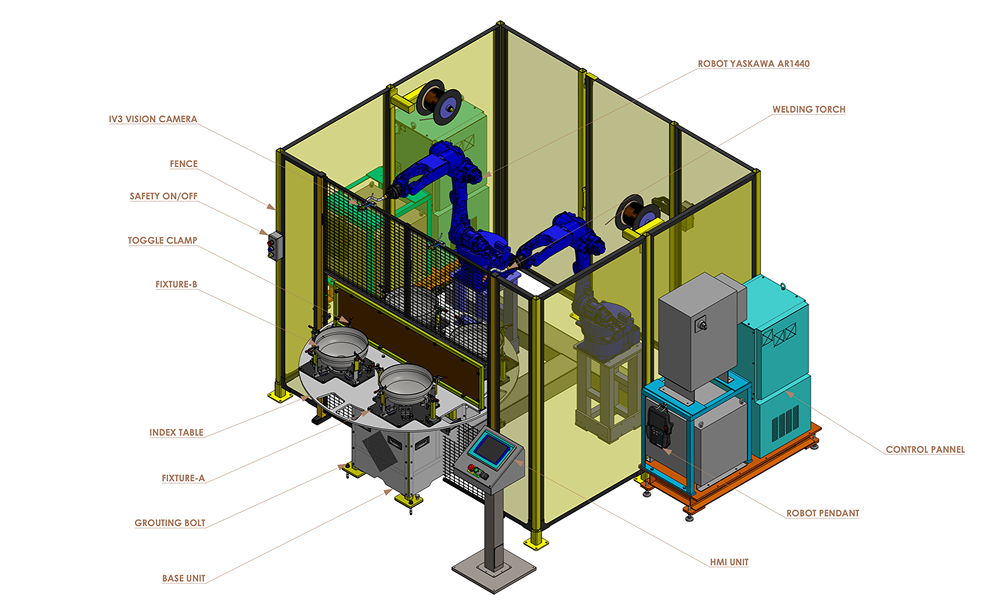
The client approached us to design a robotic MIG welding system for welding the child parts of Boiler End Caps. The system needed to accommodate two dedicated fixtures for two variants of boiler lids, mounted on an indexing table and integrated with two Yaskawa AR1440 robots for welding operations.
The primary objectives were to:
- Automate the indexing table
- Increase overall productivity and efficiency with the usage of Yaskawa AR1440 industrial robots.
- Maintain high precision, safety standards, and reliability in product handling.
- Minimize human error and enhance workplace safety.
- Reduce manual labour dependency and associated operational costs.
- Enable flexible handling of different fixture types on a single platform.


Challenge
Designing a custom robotic MIG welding system to meet the client’s process requirements involved several key challenges:
- Balancing payload and performance: Designing an indexing table coupled with a Neugart gearbox and Festo servo motor that could support four welding fixtures without exceeding the payload limit.
- Fixture design for multiple variants: Designing two fixtures to accommodate two different boiler lid variants on a single indexing plate while maintaining accessibility for robotic welding.
- High-precision positioning: Ensuring the indexing plate rotates at a reliable position at high repeatability.
- Secure part clamping: Configuring the fixture to securely hold and support the welding of 2 different types of boiler lid child parts.
- Speed vs. accuracy: Maintaining tight tolerances and high welding speed to meet strict production targets.
- Changeover efficiency: Reducing setup time and simplifying fixture changeovers between part types to avoid delays.
- Weld quality: Ensuring uniform and defect-free welds across all parts and orientations despite varying geometries.
Solution
To achieve the required automation and precision, our team analyzed the client’s setup, production goals, and welding process in detail. Applying our research-driven approach and industrial automation expertise, we engineered a compact robotic MIG welding system optimized for accuracy, efficiency and safety.
Here’s our step-by-step solution:
1. Custom fixture design
To meet the automation and precision requirements of the project, two dedicated custom fixtures were designed, each capable of holding four boiler lids and their child parts. Both fixtures were mounted on a single indexing plate.
2. Automated indexing system
The indexing plate rotation was automated using a FESTO servo motor paired with a Neugart high-precision planetary gearbox, ensuring accurate and repeatable positioning during every welding cycle. This setup formed the foundation for a fully automated and synchronized welding process.
3. Robotic welding integration
The system was equipped with two Yaskawa AR1440 industrial robots, exclusively dedicated to welding the Boiler End Cap child parts. These robots were programmed to deliver precise, consistent welds across all fixture positions, ensuring uniform quality and meeting strict production cycle times. Their synchronized operation with the indexing table enabled a continuous workflow, minimizing idle time and maximizing efficiency.
4. Fixture functionality and clamping
Each fixture was designed to accommodate two different types of child parts, secured using mechanical toggle clamps for stable holding during welding. This design allowed quick and efficient manual loading/unloading while maintaining precise positioning. By opting for toggle clamps instead of pneumatic or sensor-based systems, the setup remained simple, cost-effective, and low-maintenance. This approach reduced potential failure points and overall system complexity.
5. Safety and control system
The entire system was programmed with a strong focus on safety. It is enclosed by a protective fence featuring a maintenance door with safety interlock. Robot operations are managed through designated programs controlled via HMI (Human-Machine Interface) and PLC (Programmable Logic Controller).
Additionally, an IV3 vision camera detects part presence after loading and inspects weld beads post-welding to ensure process reliability and quality assurance.
Sedin Engineering automation and design team worked together to deliver a fully functional robotic MIG welding cell on time. We developed detailed 3D CAD models, 2D manufacturing drawings, and complete documentation, including robot reach studies, simulation reports, and electrical schematics.
All designs complied with ISO, ANSI, and CE safety standards, ensuring reliability and operator safety. The final design package enabled the client to proceed smoothly with fabrication, integration, and commissioning of the robotic MIG welding system.
Value and Benefits
Automation of the indexing table and welding process significantly improved cycle times and overall throughput.
Operator-friendly loading system with built-in safety features minimized manual tasks, reduced reliance on skilled labor, and lowered labor costs.
Custom toggle-clamp fixtures handled multiple part types in one setup, simplifying maintenance and increasing flexibility.
The modular design allowed easy upgrades, new part variants, or higher production capacity with minimal changes.
Two Yaskawa AR1440 robots delivered precise, repeatable welds, reducing rework and long-term maintenance.
Related Case Studies


Semi-Automated Leak Testing Machine Design
Improved productivity and ensured precise leak testing for cylinder heads with our advanced automated solution, trusted by top manufacturers.


Vision Inspection Stand-Alone Machine Design
Designed a compact robotic vision system that inspects automotive spoilers with high accuracy, safety features and flexibility for multiple variants.


Automated Ultrasonic Welding Cell Design
Advanced ultrasonic welding cell designed for automotive rear step pads, boosting weld accuracy, efficiency, and safety with cutting-edge robotic and quality monitoring systems.