Expert Plant Simulation Services
Identify manufacturing line challenges early in the design stage to validate, optimize and deploy production systems more safely and efficiently.


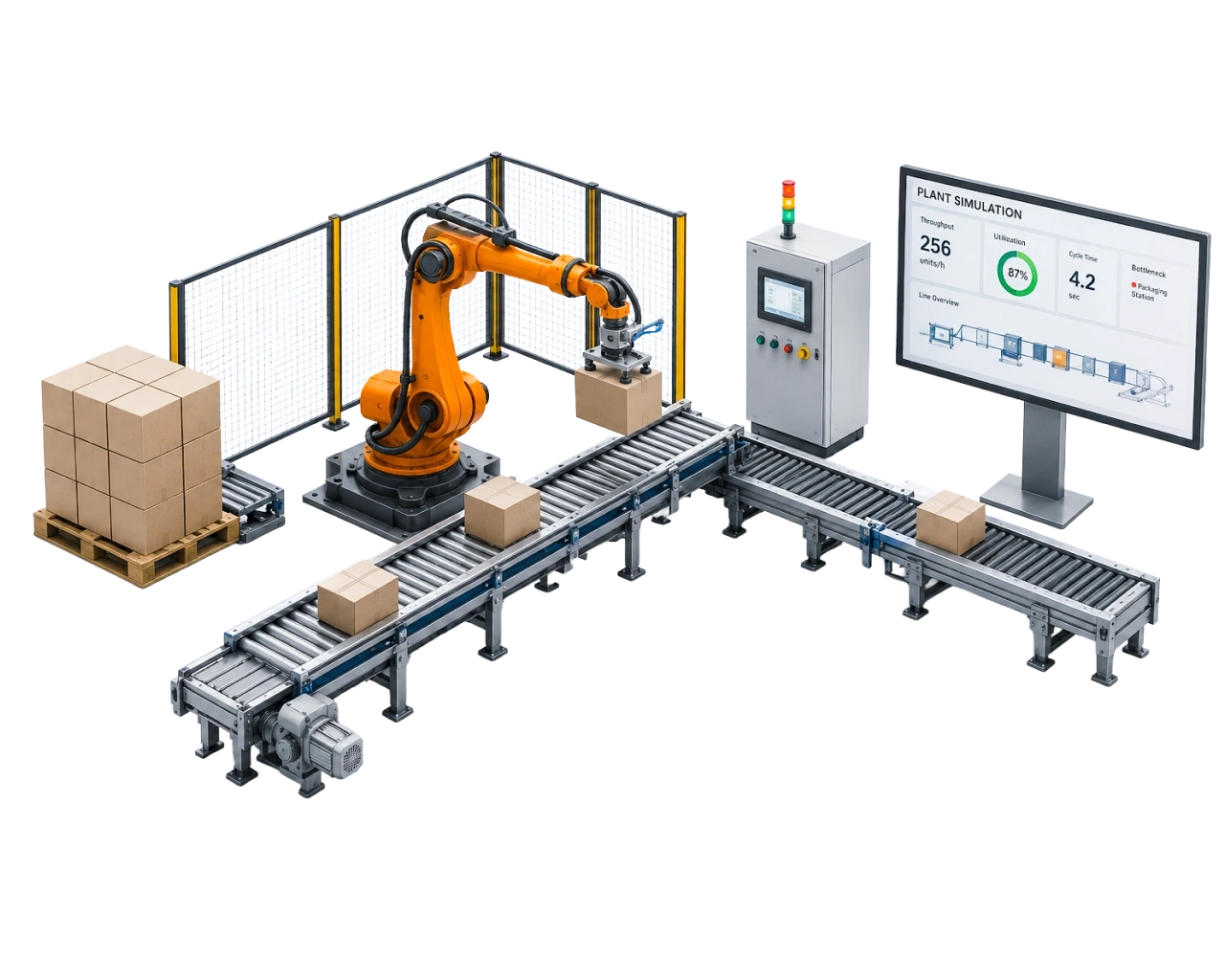
Robotic Simulation & Offline Programming (OLP)
We provide robotic simulation services that help validate robot reach, motion paths, collision zones, workspace accessibility, and cycle times before deployment. Simulation studies are developed using platforms such as Siemens Process Simulate, ABB RobotStudio, FANUC ROBOGUIDE and KUKA.Sim based on project requirements.
Our offline programming (OLP) services help manufacturers program and validate robotic tasks, motion paths, and production sequences in a virtual environment before on-site implementation begins. This helps reduce on-site programming time, manual rework, production disruption, and troubleshooting during deployment and startup.
Our simulation engineers support:
- Robot reach and motion analysis
- Collision detection
- Robot path optimization
- Cycle time validation
- Offline robot programming
- Robotic work cell validation
Plant Process Simulation


Our process simulation services help manufacturers analyze production flow, workstation utilization, material movement, and manufacturing logistics before production systems are deployed on the shop floor.
These studies help identify bottlenecks, improve throughput, validate process changes, and optimize resource utilization across production lines and manufacturing operations.
Support includes:
- Production flow simulation
- Material flow analysis
- Line balancing studies
- Throughput analysis
- Workstation utilization studies
- Production process validation
Work Cell Design & Validation


Robotic work cells are designed and validated based on production requirements, robot accessibility, operator interaction, safety requirements, and manufacturing workflow.
Our work cell validation studies help identify layout issues, weld accessibility challenges, robot reach limitations, safety concerns, and process inefficiencies early in the design stage before physical implementation begins..
Support includes:
- Robotic work cell layouts
- Robot and peripheral placement
- Ergonomic validation
- Weld spot accessibility studies
- Safety clearance validation
- Greenfield and brownfield line studies
Benefits of Plant Simulation Services
Plant simulation helps manufacturers evaluate complete production systems before physical implementation begins. Simulation studies make it easier to analyze robot movement, workstation layouts, material flow, production sequences, and cycle times across robotic work cells, assembly lines, packaging lines, welding lines, and entire manufacturing plant operations.
This helps identify bottlenecks, layout conflicts, robot accessibility issues, process inefficiencies, and material handling challenges earlier in the project — reducing implementation risks, rework, production disruption, and costly changes later during deployment and startup.

Early bottleneck detection
Plant simulation helps identify production bottlenecks, layout conflicts, robot reach limitations, and material flow issues early in the design stage.
Improved cycle times
Simulation studies help optimize robot paths, workstation layouts, line balancing, and production sequences to improve throughput and reduce unnecessary movement.
Reduced rework during deployment
Validating production systems in a virtual environment helps reduce on-site corrections, programming changes, and troubleshooting during implementation.
Better work cell validation
Simulation helps validate robot accessibility, safety clearances, equipment placement, and overall work cell layout before deployment.
Improved production flow
Process simulation helps analyze workstation utilization, material movement, and manufacturing flow to support more stable production operations.
Lower commissioning risk
Offline programming and simulation help identify potential issues earlier and reduce deployment and commissioning risks later in the project.
Technologies We Use
AUTOCAD * SOLIDWORKS * AUTOCAD ELECTRICAL
PTC CREO * INVENTOR * E-PLAN
FANUC ROBOGUIDE * AUTODESK VAULT * SOLIDWORKS PDM
ALLEN BRADLEY * DASSAULT DELMIA * VENTION
3D EXPERIENCE * FACTORY TALK * SIEMENS TECHNOMATIX
MITSUBISHI ELECTRIC * SCHNEIDER ELECTRIC * SIEMENS AUTOMATION
ABB ROBOSTUDIO * CODE SYS * B&R
GE DIGITAL * KAWASAKI * MOTOMAN
OMRON * KUKA SIM
Industries We Serve

AUTOMOTIVE

INDUSTRIAL AUTOMATION

PACKAGING

FOOD & BEVERAGE

METAL FABRICATION

AGRICULTURE

MATERIAL HANDLING

DAIRY PRODUCT MANUFACTURING

MANUFACTURING

HEAVY MACHINERY

MEDICAL

ENTERTAINMENT

WAREHOUSE
Industrial Standards
Frequently Asked Questions
Plant Simulation Services FAQs
Related Engineering Services